
What I Read: Q1 2023

My reading list from the first three months of 2023.

  • On The Shortness of Life by Seneca (Jan ’23 | Score: 4/5): A short, self-reflective book that challenged how I think about time and priorities. It may have been written hundreds of years ago, though I find it amazing how relevant and applicable the concepts still are. The first section is well worth the read and the occasional reread. It will be time well spent.

  • Atomic Habits by James Clear (Jan ’23| Score: 4.5/5): New year, new habits? That was my thought and a good thought it was. In short, I think the strategies and tactics to drive personal improvements are very useful. However, my biggest takeaway was that the book is incredibly well written. As a primer, I recommend the episode with James on Peter Attia’s podcast. JC covers the key highlights, which serves as a good intro to the concepts.

  • I Will Teach You to be Rich by Ramit Sethi (Feb ’23 | Core: 3/5): This book sat on my shelf for two years before I finally invested the time to read it. The recent wedding and new year had me due for a “financial” refresh. I found it to be a useful guide with a focus on the fundamentals and simple advice for the key financial use-cases (e.g., buying a car, getting married, etc.) It is not a pager turner, but I plan to revisit it when considering a significant financial decisions in the future.

  • A More Beautiful Question by Warren Berger (Feb ’23 | Score: 5/5): “A beautiful question is an ambitious yet actionable question that can begin to shift the way we perceive or think about something – and that might serve as a catalyst to bring about change”… I think that tagline sums it up well. The book is a philosophical yet pragmatic guidebook about the art and science of questions. I found it to be a useful tool to help spark my own curiosity and foster more productive conversations at work. Top book of 2023 thus far.

  • The Comfort Crisis by Michael Easter (Mar ’23 | Score: 4/5): Life lessons littered throughout the author’s adventure into remote Alaska. The book challenges “modern comforts”, yet offers simple and applicable habits to refocus on the fundamental aspects of life. While the writing style is sporadic, the Comfort Crisis is an easy read with introspective elements. If you read this and enjoy, then I highly recommend A Lion Trackers Guide to Life. Similar style, yet less ice and snow. More safari and sunshine.

  • Bonus Audio Book: Killing England: While it started slow, the book evolved into an engaging deep dive into the American Revolution and the remarkable men who lead it. I found it to provide enough level of detail to enrich the story, but not get bogged down in the manusha of dates, names, etc. Would recommend for history fans.

  • In addition to what I read, there is also a list of what I stopped reading for one reason or another; From Start-up to Grown-up (… poor writing) and The Socialization of American Medicine (… too scientific).

What is on the top of your shelf? Anything good?

NH.
Decisions.

There is a fundamental question to answer with any decision: is it permanent?

If yes… gather input, assess the options, and make an educated decision.

If no… go with your gut and move on. You can change it later or will have learned a low-risk lesson.

Obvious, maybe. In the moment, maybe not.

Know the permanence. Save time.

Self-Help. Simplified.

Noise. The self help industry is full of it.

Do this, do that. The noise grows louder from packed bookshelves.

The intent is “help,” yet the result is often overwhelm.

Time to quiet down. I offer a simple framework to self-reflection;

  • Am I happy?
  • Am I doing my best?
  • Am I making a positive impact?

The answer will not always be yes. Life happens.

But, the simple act to ask the questions will create enough space to move towards yes. Try it.

NH.

Inspiration.

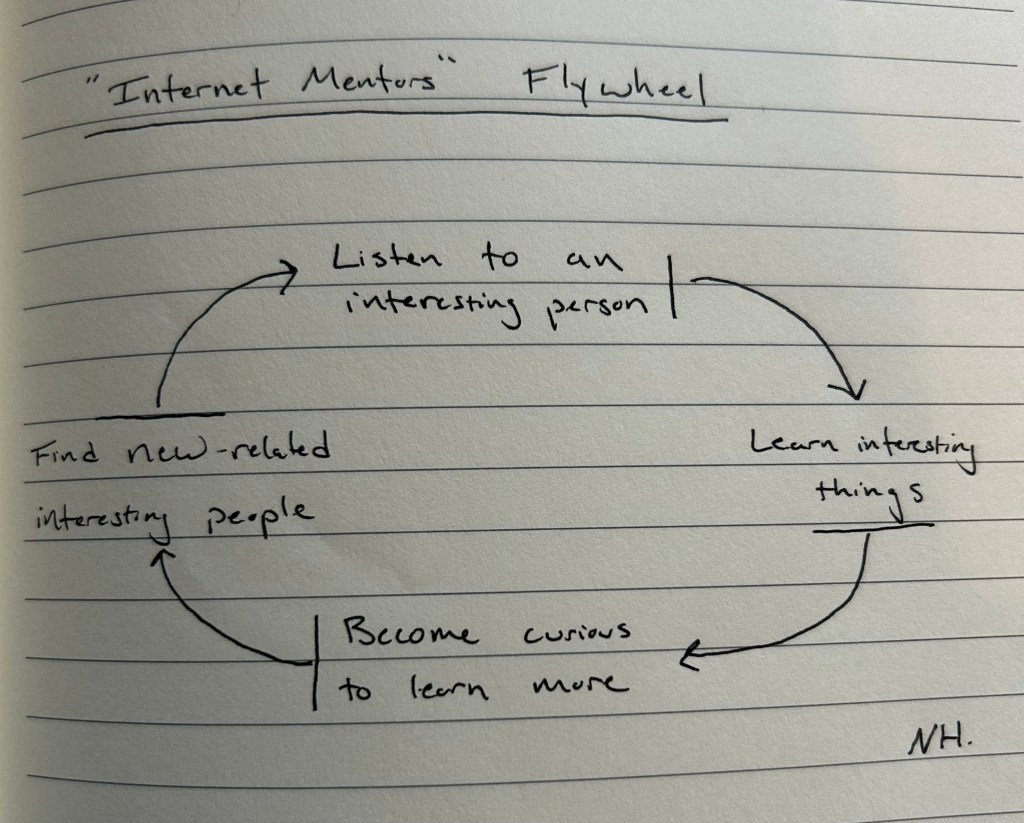
Internet Mentors. noun; “an advisor or teacher that has no personal relationship with the mentee.”


The world is flooded with information. Books, podcasts, the internet, etc. People face an unprecedented amount of content. Most of it is garbage (in my opinion) however; this phenomena has its benefits. Notably, every day people have access to more remarkable, non-mainstream, thinkers.

Over the years, I developed a list of my favorite “creators.” People that have resonated and taught me the most. I call these people my “internet mentors.” A list that includes; Tim Ferriss, Ryan Holiday, and Seth Godin.

Why are these the favorites? Two reasons.

First, they are passionately curious and experts in questions. Second, they foster engaging conversations with interesting people.

The result? I grow my knowledge across a range of topics, but I also expand my list of “internet mentors.”

A recent example of this “expansion” is Rich Roll. I heard about Rich on a podcast episode with Tim Ferriss.

Rich has a one-of-a-kind life. My words couldn’t do it justice, but his transformative story had a profound impact. He overcame serious addiction to unlock his physical potential and achieve spiritual fulfillment.

Rich’s openness to reveal his personal scars is a model of true courage. It inspires me to share more about my inner self and energizes me to test my own limits. In short, I am grateful for Rich (and people like him). His story leads to my benefit.

He recently released a “docu-short” about his life. Take the 15-minutes to watch. You won’t regret it.

NH.

//

“… the pain of circumstance has to exceed the fear of change.”

Rich Roll
Credit: Rich Roll + Solomon.TV

Clear Thinking.

“It is slothful not to compress your thoughts” – Winston Churchill

//

I recently finished the book, The Splendid & The Vile by Erik Larson. A remarkable expose of Winston Churchill during WWII. The book left me with numerous takeaways, but maybe none bigger than; Churchill’s focus on communication.

Let me explain.

Germany was on England’s doorstep. Churchill faced countless decisions with little time to make them. Each moment had to count.

How did he make it all work? Churchill demanded brevity. His staff were to deliver all memos in a page or less. And, he never hesitated to call them out if they did not.

This paid dividends in two ways. First, his mandate coached the staff to focus on the facts and summarize the options in plain English. And, second, Churchill could efficiently consume the information and make the necessary decisions.

As William Zinser said, “clear thinking becomes clear writing; one can’t exist without the other.” Churchill challenged, more so required, all of his government to think and communicate in this way.

… as you know, the result worked out for him.

NH.

///

P.S. I highly recommend William Zinser’s book On Writing Well. It was a gift that continues to give.

A Side Effect of Innovation

When it came to dinner time, my mother had one rule; no phones at the table.

Dinner was a sacred event. A time for family and friends to break bread, share stories, and simply be present. This mentality was not lost on me. I still approach each meal in the same way.

However, a recent innovation is challenging my mom’s rule; QR code menus.

Electronic menus have trained a new behavior. Sit down, take your phone out, and review the menu. Oh, and check the text that just came in. While brief, this mandatory action robs our attention before the meal even starts.

So, this raises a question…. is all innovation a sign of progress? I’d argue no. Not in this case.

NH.

///

P.S. I realize that electronic menus have saved countless trees. I won’t debate the positive environmental impact. Just call me old fashioned on this one.

Or, beware.

When asking a question, people (especially, me) have a tendency to ask is the answer this OR that? Are the company’s processes inefficient because of the poor technology or lack of employee training?

What if it is neither? What if the business is understaffed, employees are overworked, and morale has hit rock bottom? That could be a problem…

While this may be a broad example, it highlights the key point… beware of “OR” when asking questions.

OR is often an educated attempt to pin-point an answer. Based on the available information, the answer must be A or B. Black or white. What about the grey? Thats the risk that comes with the almighty OR. OR can box-in the thinking (and the responder) into two paths… this or that.

So, what is the alternative? Fight the temptation to assume and leverage open-ended questions. Ask the whats, whys, hows, to guide the responder down whichever path the answer may lead. Who knows where it may just end up.

NH.

A Lean Life.

I was asked a question recently, “how do you know if your daily actions align to your long-term goals?” A simple question, yet one that has bounced around my head over the past few months.

See, I’m like anyone else. I set goals and develop plans to achieve them. However, fast forward a few weeks or months and the goals are still unmet. Maybe life or work, something had gotten in the way. Sh*t happens, ya know?

So, how to solve for this? What systems can help better achieve desired outcomes? I’ve chased an answer through books, talks, and writing in recent months. And, I ended up with a viable approach closer to “home” than I anticipated. It may just work for you as well…

///

Agile. A popular term in today’s business world. While interpretations vary, the target benefits are consistent. Become more adaptive, shorten feedback loops, increase focus on value, etc. All good things.

A lesser known component of agile organizations is a concept called, Lean Portfolio Management (or “LPM” for short). By the books, Lean Portfolio Management aligns strategy and execution by applying systems thinking to investment funding, agile portfolio operations, and governance (according to Scaled Agile).

In layman’s terms, LPM is an approach for companies to plan, fund, and govern their work. A framework to translate (top-of-house) strategic objectives into desired business outcomes – through effective and efficient investment of people and dollars. Summed up in a simple question, “are we investing our (fixed) resources in the right places to get the right outcomes?”

Sounds like a reasonable target, though one to unpack. Why do companies adopt lean portfolio principles?

  • They are “stuck” in long-term planning cycles with limited ability to change direction
  • They have no idea if their investments actually move the “needle” towards their long-term goals
  • And, most of all… they lack accountability to deliver planned outcomes (or at least learn from them)

I recently designed a target state (LPM) program for a client. As that project came to a close earlier this year, I was hit with a realization. Why can’t this LPM framework be applied to the same pain points of my own goal-setting journey? I set out to test this hypothesis with my own life… “a lean approach to life.

///

So, how does LPM work in practice?

It all starts with a Vision. “Who or where do I want to be in a year from now?” Potentially, a hard question, but a foundational one to set direction. It also feeds the next key question; “what do I need to accomplish in the next 3-months to build towards that target?”

  • Disclaimer, this activity may even trigger the always fun existential question; “what am I doing with my life?” The intention isn’t to have all the answers. It is about getting started then adjusting along the way.

Next, came Allocation. “How should I invest my resources?” Like (almost) everyone else, I have a fixed amount of time, money, etc. So, in practice the question became; “where is my time and money best spent in the next 2-4 weeks?”

  • Remember, this is an exercise in trade-offs. By saying yes to this, I am saying no to that. I like two quotes to reinforce this. First, as Peter Drucker said, “People are effective because they know how to say no,” and second, “You must be single minded. Drive for the one thing that you’ve decided,” as the great General George Patton said.

Finally, Accountability. “How will I track against my plan?” The LPM framework presents an adaptable cadence:

  • A Monthly “Personal Sync”: A once-a-month hourly session to reflect on current progress. Think, “how am I tracking against my goals? Then, where do I need to adjust course?
  • A Quarterly “Personal Planning”: A once-a-quarter two-hour planning session to reset my key priorities and desired outcomes for the next three months. Think, “what do I need to accomplish during the next three months to stay on course with my desired target?
  • Disclaimer; a “set-it and forget” approach between sessions will set you up for failure. The more active you are to check-in on status, it will only increases success. Otherwise, you risk falling into a “guilt trap” at your next monthly sync when you realized that you got nothing done 😞 .

///

Sounds reasonable. So, how could you get started?

  • Plan; Define an outlook for the year. “What are you looking to accomplish?” Deconstruct that into what do you need to accomplish in the next 3-months to build towards that annual outlook. And, yes that means write them down. I use google sheets, but use whichever tool you prefer (including paper, a whiteboard, etc.)
  • Schedule; Open your calendar and plan each month’s personal sync (1-hour) and each quarter’s personal planning (2-hours). I prefer a Saturday morning due to limited distraction, but once again pick whichever day works for you.
  • Show-up; This one explains it self (and is the most important in my opinion). Commit to “show-up” to each session and reward yourself when you do. For me, I head to my favorite coffee shop and order-up 20 oz of caffeine.
  • Adapt; Whether it is your outcomes, or this approach, take time to reflect. “Are you achieving your outcomes? Is this framework useful?” Answer those, and be prepared to adjust. Remember, the intention is to help you achieve outcomes, not create administrative overhead.

That’s it. Some upfront thinking, and a few hours each quarter. Easy enough? Maybe.

It has helped my life, but is certainly not “one-size” fits all. It is one (of many) approaches to better manage your most precious resource; time.

Cheers.

NH.

The Exam Question

In school we are taught, tested, and graded. And, naturally trained that the latter matters the most. Whatever it takes to get the A. Therefore, we can’t help but ask, “will this be on the test?”

While we can debate if this is “effective” learning, it recently raised a question in my mind… why not apply the same frame to life?

Whether a meeting at work or a situation at home… why not ask; what is the “exam” question?

Because if we don’t nail the exam question, then how do we know that we got the right answer? (… and the effort and energy to find that answer was worth it.)

NH.