This is Water.

“What the hell is water?”.

A quote from the infamous David Foster Wallace commencement speech titled This is Water.

The 20-minute monologue is littered with golden life advice, though none more potent than the concept of “default mode.” AKA, the natural human wiring to view the world through a self-centered lens that can cloud empathy, patience, and restraint.

I’m certainly guilty of it. I think most people are.

It is hard not amid the routine of everyday life. That is why my wife and I created a game of it. When one (or both) of us becomes agitated with a situation, the other will call out “default mode” or a personal favorite; “are we the ones fucked up here?”

In either case, the subtle question serves as a quick jab to wake up, detach the self-centered lens, and take an objective view. We land in a better mindset to help someone else… Or, at least laugh at the comedy that is human nature.

Try it.

The next time a precarious situation arises and you really want to blame another person or give somebody the business… ask yourself, “default mode?”

Cheers. NH.

A Lean Life.

The following was originally posted in 2022. It highlights my annual planning framework, which was front of mind as the calendar turned to 2024. The approach is not one-size fits all, but you may find it useful. Cheers.


I was asked a question recently, “how do you know if your daily actions align to your long-term goals?” A simple question, yet one that has bounced around my head over the past few months.

See, I’m like anyone else. I set goals and develop plans to achieve them. However, fast forward a few weeks or months and the goals are still unmet. Maybe life or work, something had gotten in the way. Sh*t happens, ya know?

So, how to solve for this? What systems can help better achieve desired outcomes? I’ve chased an answer through books, talks, and writing in recent months. And, I ended up with a viable approach closer to “home” than I anticipated. It may just work for you as well…

///

Agile. A popular term in today’s business world. While interpretations vary, the target benefits are consistent. Become more adaptive, shorten feedback loops, increase focus on value, etc. All good things.

A lesser known component of agile organizations is a concept called, Lean Portfolio Management (or “LPM” for short). By the books, Lean Portfolio Management aligns strategy and execution by applying systems thinking to investment funding, agile portfolio operations, and governance (according to Scaled Agile).

In layman’s terms, LPM is an approach for companies to plan, fund, and govern their work. A framework to translate (top-of-house) strategic objectives into desired business outcomes – through effective and efficient investment of people and dollars. Summed up in a simple question, “are we investing our (fixed) resources in the right places to get the right outcomes?”

Sounds like a reasonable target, though one to unpack. Why do companies adopt lean portfolio principles?

  • They are “stuck” in long-term planning cycles with limited ability to change direction
  • They have no idea if their investments actually move the “needle” towards their long-term goals
  • And, most of all… they lack accountability to deliver planned outcomes (or at least learn from them)

I recently designed a target state (LPM) program for a client. As that project came to a close earlier this year, I was hit with a realization. Why can’t this LPM framework be applied to the same pain points of my own goal-setting journey? I set out to test this hypothesis with my own life… “a lean approach to life.

///

So, how does LPM work in practice?

It all starts with a Vision. “Who or where do I want to be in a year from now?” Potentially, a hard question, but a foundational one to set direction. It also feeds the next key question; “what do I need to accomplish in the next 3-months to build towards that target?”

  • Disclaimer, this activity may even trigger the always fun existential question; “what am I doing with my life?” The intention isn’t to have all the answers. It is about getting started then adjusting along the way.

Next, came Allocation. “How should I invest my resources?” Like (almost) everyone else, I have a fixed amount of time, money, etc. So, in practice the question became; “where is my time and money best spent in the next 2-4 weeks?”

  • Remember, this is an exercise in trade-offs. By saying yes to this, I am saying no to that. I like two quotes to reinforce this. First, as Peter Drucker said, “People are effective because they know how to say no,” and second, “You must be single minded. Drive for the one thing that you’ve decided,” as the great General George Patton said.

Finally, Accountability. “How will I track against my plan?” The LPM framework presents an adaptable cadence:

  • A Monthly “Personal Sync”: A once-a-month hourly session to reflect on current progress. Think, “how am I tracking against my goals? Then, where do I need to adjust course?
  • A Quarterly “Personal Planning”: A once-a-quarter two-hour planning session to reset my key priorities and desired outcomes for the next three months. Think, “what do I need to accomplish during the next three months to stay on course with my desired target?
  • Disclaimer; a “set-it and forget” approach between sessions will set you up for failure. The more active you are to check-in on status, it will only increases success. Otherwise, you risk falling into a “guilt trap” at your next monthly sync when you realized that you got nothing done 😞 .

///

Sounds reasonable. So, how could you get started?

  • Plan; Define an outlook for the year. “What are you looking to accomplish?” Deconstruct that into what do you need to accomplish in the next 3-months to build towards that annual outlook. And, yes that means write them down. I use google sheets, but use whichever tool you prefer (including paper, a whiteboard, etc.)
  • Schedule; Open your calendar and plan each month’s personal sync (1-hour) and each quarter’s personal planning (2-hours). I prefer a Saturday morning due to limited distraction, but once again pick whichever day works for you.
  • Show-up; This one explains it self (and is the most important in my opinion). Commit to “show-up” to each session and reward yourself when you do. For me, I head to my favorite coffee shop and order-up 20 oz of caffeine.
  • Adapt; Whether it is your outcomes, or this approach, take time to reflect. “Are you achieving your outcomes? Is this framework useful?” Answer those, and be prepared to adjust. Remember, the intention is to help you achieve outcomes, not create administrative overhead.

That’s it. Some upfront thinking, and a few hours each quarter. Easy enough? Maybe.

It has helped my life, but is certainly not “one-size” fits all. It is one (of many) approaches to better manage your most precious resource; time.

Cheers. NH.

In-between.

5 minutes between meetings, 20 minutes after work, or 12 minutes before take off. Those “in-between” moments occur each day. Minute by minute, hour by hour, and day by day. Those moments add up.

Tech has captured those moments. Check the phone here, or scroll ESPN there. Those moments are captured by a screen.

How to think about that? How ought those moments be spent? Hmmm…

NH.

Goldilocks & The Six Apartments.

My time in Chicago: Seven years. Six apartments. Six moves.

That last bit usually draws an adverse reaction. “Six moves, really? I hate moving… why would you do that to yourself?”

I won’t argue that the habit is extreme. I actually blame it on my lingering case of the Goldilocks Syndrome. An internal itch to explore Chicago’s different neighborhoods to find the one that fits “just right.”

While I still maybe on that quest, there is a more subtle reason for each move. The simple question of; what is important?

Materials things pile up. A free water bottle here, another pair of jeans there, the countless items expand to fill the apartment. It’s Parkinson’s Law applied to space.

That is until moving time. An exercise that requires a thorough review and agonizing packing of those material things. Suddenly, the old fraternity t-shirts or third coffee machine don’t seem like must-haves. Do they?

Moving becomes about importance. Do I really need this? Is it worth the effort to move it? These questions foster a lean mentality, but even more so lead to an improved upstream mindset at the time of purchase; Will I really want to move this one day?

Cheers. NH.

Rethinking The Workday.

When does your workday end? How do you decide?

Historically, the clock hit five, and it was time to go home. What got done was done, and the cycle started over the next day. Work was time-bound and productivity was shift-based.

That model worked well during the industrial revolution. People were incentivized with an hourly wage and capped at forty hours per week (… heaven forbid, paying overtime).

Today, many industries and jobs still operate that way. It works just fine.

However, what about everyone else? What signals the end of the workday for the modern, salary-based employee? The business owners, executives, managers, consultants, designers, coaches, etc. When does their workday end?

When all the tasks are “done?” What about when your client logs off? Or, are you just hungry for dinner?

The workday has expanded beyond the clock. It has become elastic. I think there are two primary reasons among many; culture and technology.

The American economy is built on growth, and society is grounded in comparison. The individual is pushed to do more; therefore, the company can earn more. Meanwhile, tech continues to break down barriers rapidly. A laptop and Wi-Fi alone have enabled people to work anywhere, anytime.

These are not implied to be negative. Those two key points continue to push the world forward. However, my hunch is the expectations of a “standard” workday has not evolved with them.

Let’s take me as an example. I certainly haven’t figured it out. My day often looks like…

  • Work  8-5 PM
  • Break to walk the dog and have dinner with my wife
  • Open the laptop back up at 7 PM for another couple hours of work
  • Finally, wind down for a 10 PM bedtime (… which I usually blow past while my mind continues to formulate my to-do list for tomorrow)

Likely not ideal. Yet, those two hours between 7-9 PM are often my most productive. No meetings, no inbound messages. Just quiet time to think.

This raises another question; how might we create more quiet, non-disruptive time during the workday?

The productivity “hackers” shout tactics like “batching” work or turning off emails. Fair. Those can be can successful at an individual level. However, has your company created a culture to reinforce these “good” habits? Does the work stop for the team(s) post a specific time? Likely not, and once again, the individual falls victim to the macro-organization.

So, when does your workday end each day? How do we focus on outcomes, not just hours? How to be satisfied with a “good days” work versus more-more-more? It’s a question to continually ask oneself in a modern world where the clock may no longer be the trigger.

NH.

What I Read: Q2 2023

Another quarter, another few books. All very different, but all authors that I have come to admire. They are vulnerable to share the stories, the good and the bad, for the rest of us to learn from. I hope to do the same with SFO.

  • Outlive by Peter Attia (April ’23 | Score: 4/5): On the surface, this book may scare someone away. It is written by a Doctor, the topic is personal longevity, and it is the size of the text book. However, the book could not be more approachable. A well-published expert in the field, Peter uses Outlive to deconstruct the objective to live longer through tangible strategies and actionable tactics. While chapters can be scientific, he layers his perspective on top of leading research without getting bogged down in the detail. My suggestion; treat the book like a buffet. Skip around, but don’t miss the final chapter.

  • Bird by Bird by Anne Lamont (April ’23 | Score: 4/5): If we are handing out awards, this wins most surprisingly good book this year. The topic is academic; how to write well. Anne’s path to get there is a page turning journey of humor, vulnerability, and self-depreciation. She uses the book to arrive at a fundamental takeaway… to create a great story, you must focus on the characters, invest in their relationships, and the plot will take care of itself. The same goes for a great life.

  • Kitchen Confidential by Tony Bourdain (Audiobook) (May ’23 | Score: 5/5): Adventurous. Informative. Hilarious. A few adjectives that summarize one of my favorite books written by one of my favorite people. I read Kitchen Confidential years ago. The book jump started my admiration of Tony. He showed me a view into the kitchen, food, (and later the world, through his TV shows) that I had never been exposed to. Tony highlighted the power of food and the stories that it can tell. My recommendation? Listen to the audiobook, narrated by Tony, on your next road trip. Bon appetit.

  • Awareness by Anthony De Mello (May ’23 | Score: 2/5): I was intrigued by the premise – a practical journey to realign with our spiritual self. The book felt like a splash of ice water; chilling and awakening. However, it quickly became lukewarm 100 pages in. The message got lost among “enlightenment” rabbit holes and the redundancy wore me out.

  • Stolen Focus by Johann Hari (June ’23 | Score: 5/5): I believe everyone should read this book… The world has been flooded with information among the current social media age. I, myself, have struggled with my relationship to social media. Facebook, Instagram, Youtube… I know they steal my time and attention. Yet, I am often powerless against the urge to check them. They are embedded in “modern” life and recently, ingrained in my habits. Realizing this, I read this book as a necessary reset. The author, Johann’s, personal journey and struggles are threaded through countless insights about the attack on people’s attention (and the massive corporations behind it). This book left me feeling informed and empowered to recapture my attention. I hope others can feel the same way.

Cheers. NH.

P.S. A friend of mine sent me a book recently. It was unprovoked by him, and very appreciated by me. Consider doing the same for someone else.

Always Buy The Lemonade.

A friend gave me the advice once. “Always buy a cup when you come across a lemonade stand…”

//

We can all think back to the days of being the kid behind the rickety lemonade stand. The rush to set-up at the perfect spot on a summer Saturday morning. A disproportioned concoction of Country Time powder and water poorly stirred together. A few lowly ice cubes slowly disappearing. And, of course the white sign with the big letters; LEMONADE.

The table was set and the paying customers were due to show-up like the midnight rush at Walmart on black Friday.

Or so, we thought. The first unwelcomed lesson of the lemonade stand; patience. Because I don’t know about you, but unless you are Jordan Belfort, the timing seemed to pass slower than 8th grade math class. One customer here and another there; the earnings may have clipped $4 an hour.

However, to quit would mean to roll-up shop and sunk cost isn’t a consideration for most 8 year olds. So, instead the dreaded patience kicks in and the hours drip by. With it comes incremental success, and hopefully a full cash jar by end of day.

///

The quote continues… “because buying a cup may just lead to that kid behind the counter to grow-up into an entrepreneur.”

Your purchase may just be the pebble that generates the ripple effect. A small push to propel that kid to come back the next day then the next day.

Fast forward, and they may just become the entrepreneur with the determination to move the world forward. Buy the lemonade.

Cheers. NH.

Enough.

enough : occurring in such quantity, quality, or scope as to fully meet demands, needs, or expectations. (Source: Merriam Webster Dictionary)

///

What is enough? A simple question with complex answers.

Answers that are wildly different from our ancestors. Modern people have transcended the bottom of Maslow’s Pyramid, or at least don’t have to fear the military’s draft or a tuberculous outbreak.

(For most Americans) the answer has shifted from needs to wants. A blessing and a curse.

The curse. Material things, money, status, love, or whatever it may be… keeping up with thy neighbor (or that Instagram influencer) has never been more relevant in our more, more, more society.

This raises a return to the original question; What is enough? How to control personal demands or expectations when the “needs” are met?

Have the courage to answer that question for yourself. And re-ask it often.

NH.

COMPARISON IS THE THIEF OF JOY

TEDDY ROOSEVELT

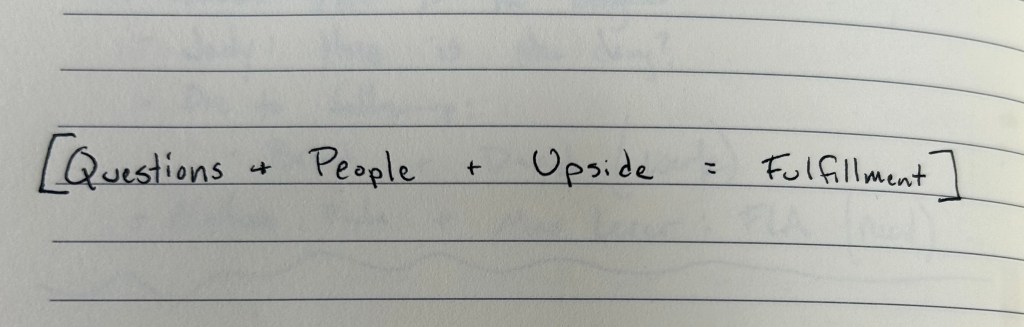
Q + P + U = F

How to simplify a career decision? Consider three things; Questions + People + Upside.

  • Questions: What questions or challenges is the company seeking to solve?

  • People: Who are the people solving them? Are they curious to keep asking more questions? Are they persistent to work towards a solution (or at least humble enough to learn from failure along the way)?

  • Upside: What is the learning opportunity? How does it translate to short- and/or long-term financial benefit?

Ultimately, you will be tasked to own those questions. Work alongside those people. And, reap that upside.

NH.